
What is fertility counselling and evaluation?
Fertility counselling and evaluation is the work-up done when a pregnancy is taking longer than expected. It looks at both partners. Ovulation, the fallopian tubes, the uterus, sperm, and hormones can each be the reason, and more than one of them can be present at the same time. Guessing from cycle apps, or starting medicines before those questions are asked, often wastes months.
The counselling part is the explanation. You should leave knowing what was found, what is still unknown, and which treatment matches that finding. That may be timed intercourse, a follicular study, ovulation medicines, or intrauterine insemination. If in-vitro fertilisation is the more suitable next step, that is said plainly and a referral is discussed. Treatment is not started in the same breath as the first history.
Dr. Anusha Mallarapu offers this evaluation in Puppalaguda. Her training includes a FOGSI fellowship in infertility, alongside laparoscopy and hysteroscopy. The clinic visit is where the history and the plan are made. Hospital tests are arranged from that plan, not booked before the reason is clear.
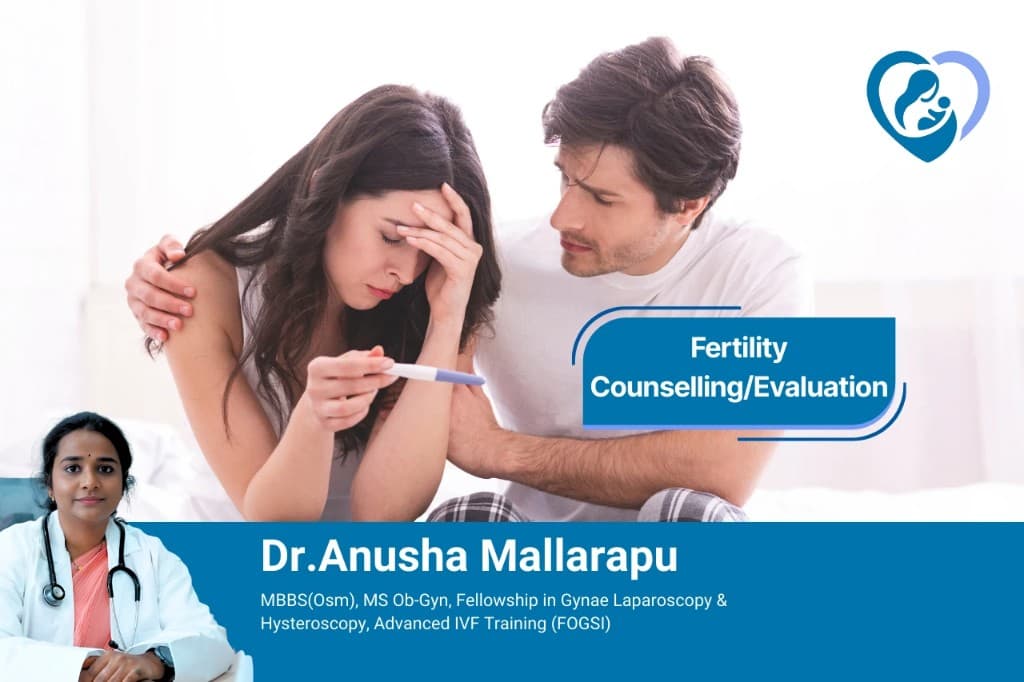
How the work-up runs
The order matters. History first, then the tests that can change the plan, then a named next step.
Both histories
Cycle length, how long you have been trying, previous pregnancies, pelvic infection or surgery, and medicines are recorded for the woman. For the man, the history covers illness, surgery, smoking, and any earlier semen test. How often you have intercourse in the fertile days is asked, because timing alone sometimes explains the delay.
Examination and the first tests
An examination is done when it will add information. Blood tests are timed to the cycle when the day matters. A semen analysis is arranged with instructions for the sample. Tests are not sent as a bundle on day one if the history already points to one cause.
Looking at ovulation and the pelvis
A follicular study shows whether a follicle is growing and when ovulation is likely. An ultrasound looks at the uterus and ovaries. If the tubes or the cavity still need to be seen, that test is explained separately, including what it involves, before it is booked.
A plan you can repeat back
At the review visit the results are put in one explanation: what is normal, what is not, and what to do next. If the plan is IUI or ovulation induction, you are told what that involves. If IVF is the better option, the reason for referral is the same conversation.
What the evaluation covers
These are the questions the work-up is built to answer. Not every couple needs every test.
Ovulation
Irregular cycles, very long cycles, or cycles with no clear fertile days raise the question of whether an egg is being released. A follicular study and, when needed, a hormone test answer that. Ovulation medicines are not started until this is known.
Hormones, thyroid, and ovarian reserve
Blood tests look for a thyroid problem, a prolactin problem, and the hormone pattern of irregular ovulation. Ovarian reserve testing is used when age, a previous surgery, or a poor response would change how quickly treatment should move. A number on its own is not a diagnosis.
The male partner
A semen analysis looks at count, movement, and shape. It is part of the first work-up, not an afterthought once the woman’s tests are finished. An abnormal result is explained, and a repeat or a referral is arranged when one test is not enough to decide.
Weight, smoking, and timing
Diet and exercise advice is specific: weight that is affecting ovulation, smoking, and intercourse that is missing the fertile days. General wellness tips are not offered as a substitute for a test that is still needed.
Who should book an evaluation
Book when trying has gone on long enough that guessing is no longer reasonable, or sooner if a known problem is already in the history.
01
Trying for a year, or six months from 35
A year of regular unprotected intercourse without a pregnancy is the usual point to investigate. From about 35, six months is a better threshold, because waiting a full year costs more time.
02
Cycles that are irregular or absent
If periods are very irregular, you do not need to complete a year of trying before asking whether you ovulate. The evaluation can start from that history.
03
A known pelvic or sperm problem
Previous pelvic infection, endometriosis, fibroids, a semen result that was abnormal, or a surgery on the tubes or ovaries is a reason to be seen earlier. Bring the old reports.
04
Repeated pregnancy loss
More than one miscarriage is a different question from not conceiving, and it still belongs in this consultation. The tests are chosen for loss, not copied from a standard infertility panel.
Come as a couple if you can. A plan made from one partner’s tests is incomplete, and the counselling is easier when both of you hear the same explanation.
How the results are used
The evaluation is finished only when it points to a next step. These are the paths used in this practice.
Trying with better timing
If ovulation is happening and the semen analysis is adequate, a follicular study can show the fertile days of the next cycle. Intercourse is then timed to that scan. This is a complete plan for some couples. It is not a delay tactic when a tube or a severe sperm problem has already been found.
Ovulation induction and IUI
When an egg is not being released reliably, or when insemination is the right next treatment, ovulation medicines and IUI are available in this practice. They are started from the evaluation, with the cycle monitored, not prescribed as a standing course without a scan.
When IVF is the better option
Blocked tubes, a semen result that will not support simpler treatment, or several failed cycles of IUI are reasons to discuss IVF. Dr. Mallarapu will say when referral is the better use of time. The evaluation you have already done is what that referral is based on.
What happens at the first visit
The first visit is history and an explanation of which tests are useful. Previous scans, semen tests, and operation notes shorten the work-up. A pregnancy test is done if there is any chance you are already pregnant.
An examination and a pelvic scan may be done the same day if the timing of the cycle allows it. Blood tests that must be taken on a particular day are scheduled, not drawn on the wrong day for convenience. The man is given clear instructions for the semen test. A review date is fixed so the results are read together, not dribbled out as each lab report arrives.
What to bring
- Cycle dates for the last few months, and how long you have been trying.
- Earlier scans, blood tests, semen reports, and any operation notes.
- A list of medicines and supplements, including anything bought for fertility.
- Both partners, if the man can attend. If he cannot, bring a recent semen report or be ready to book his test.
Call +91 63048 27743 or use the appointment form. The clinic confirms the time by phone or WhatsApp, Monday to Saturday. Mention that the visit is for fertility, and say the first day of the period if it has just started, so tests that depend on cycle day are not missed.
Why couples book this evaluation here
01
Infertility training in the same clinic
Dr. Mallarapu’s practice includes a FOGSI fellowship in infertility. The evaluation, the follicular study, and IUI sit in one place, so the history is not restarted with each step.
02
Both partners are in the plan
Semen analysis is part of the first work-up. Treatment is not built on the woman’s tests alone and then revised months later.
03
The next step is named
You are told whether the next cycle is timed intercourse, medicines, IUI, or a referral for IVF. The reason is the results, not a fixed sequence of treatments.
04
The strain of trying is acknowledged
The visit includes time for what the delay has been like, and for disagreement between partners about what to do next. That conversation is part of the counselling.
Questions about fertility evaluation
01What does a fertility evaluation involve?
A history from both partners, an examination when it will help, and tests chosen for your case: ovulation and hormone tests, a pelvic scan or follicular study, and a semen analysis. Tube tests are added if the history or the first results say they are needed. You then get one explanation and a named next step.
02How does infertility training change the visit?
Dr. Mallarapu holds a FOGSI fellowship in infertility, with laparoscopy and hysteroscopy. The evaluation is planned by someone who also does the cycle monitoring and IUI, and who knows when those are no longer the right treatment. The fellowship is training. It is not a promise of a particular chance of pregnancy.
03Is there support for how this feels?
Yes, within the consultation. The delay, the tests, and disagreement about treatment are discussed in ordinary language. This is not a separate counselling programme. If anxiety or low mood needs its own care, that is said, and you are not told that stress alone explains the infertility.
04What are the first steps?
A consultation for the history and the likely causes, then the first investigations timed to the cycle. Come with whatever reports you already have. A review is booked so the results are read together before any procedure is started.
05What if we need more than this clinic provides?
Ovulation induction and IUI are available here. If the results show that IVF or another assisted treatment is the better next step, Dr. Mallarapu explains why and refers you with the evaluation already done. You are not asked to repeat the same tests without a reason.
06Where is the clinic?
Dr. Anusha Mallarapu Clinic is on the first floor of Ideal Investa, Road No. 13, Kundan Nagar Colony, Alkapoor Township, Puppalaguda, Hyderabad 500089. She also consults at Bhoomi Hospital, Plot No. 44, 46 and 48, Puppalaguda–Manikonda Road, near Tapovan Park.
07How do I book an appointment?
Call +91 63048 27743, email dranushamallarapu@gmail.com, send a WhatsApp message, or use the form on the Contact page. The clinic confirms the time by phone or WhatsApp.
08What should I bring to the first visit?
Bring previous prescriptions, scan and blood reports, a list of current medicines, and the questions you want answered. If this is a fertility visit, come with your cycle dates if you know them.
Sources
These public pages explain the topic in general. They are not a description of your own result or a treatment plan from this clinic.
Related notes
- 16 September 2026What a fertility work-up includes before treatmentHow fertility counselling works for couples in Puppalaguda: history first, tests that change the plan, and a named next step before any procedure.
- 12 September 2026What happens at a pregnancy visit in PuppalagudaWhat a pregnancy visit with Dr. Anusha Mallarapu covers: history, checks, scans, and a birth plan aimed at a safe vaginal delivery.