
What is a follicular study?
A follicular study is a series of ultrasound scans across one menstrual cycle. Each visit looks at the ovaries for follicles, the fluid-filled sacs in which an egg matures, and at the uterus for the thickness of the lining where a pregnancy would implant. The aim is a clear record of that cycle, not a single picture taken on a convenient day.
One scan cannot show whether you ovulate. Follicles change size over several days, and ovulation is an event with a date. Repeating the scan at planned intervals shows which follicle is becoming dominant, how fast it is growing, and when it is likely to release an egg. That sequence is what the doctor uses to time intercourse, ovulation medicines, or intrauterine insemination.
Dr. Anusha Mallarapu offers this monitoring as part of fertility care in Puppalaguda, for couples trying on their own, for irregular cycles, and for ovulation induction or IUI. If IVF is the better next step, the same record is part of that discussion.
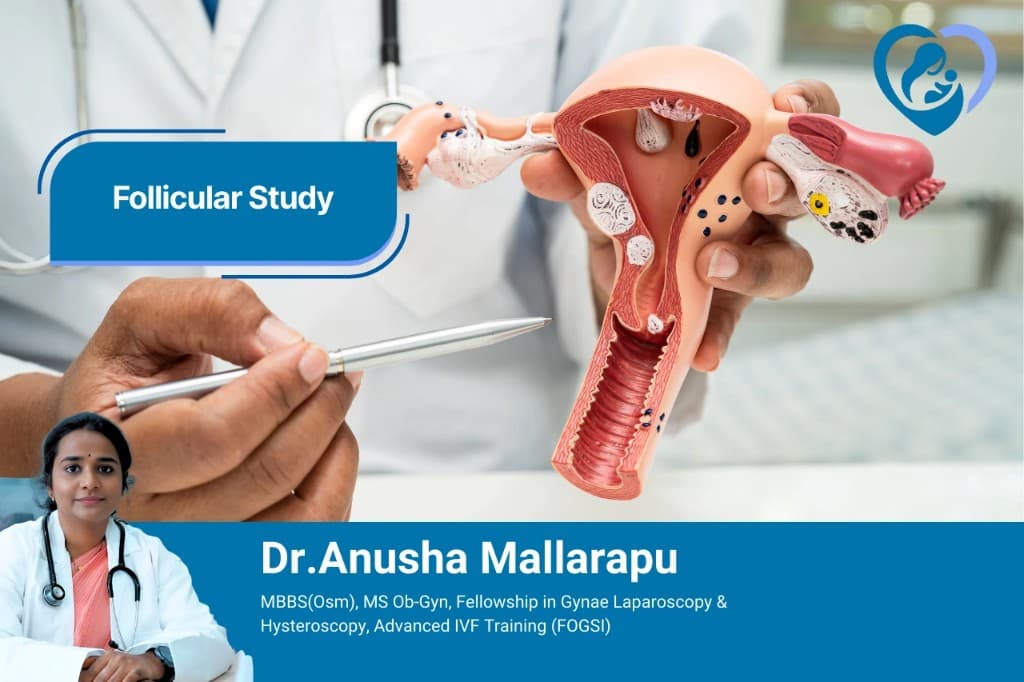
How a cycle is followed
The study usually starts on day 2 or day 3 of bleeding, unless you are asked to come on another day. Visits are then booked through the cycle until ovulation can be predicted.
Baseline scan
The first visit checks that the ovaries are quiet, looks for a cyst that would change the plan, and notes the lining before a follicle begins to grow. Any medicines are decided from this scan, not from the calendar alone.
Growth visits
Scans are repeated every one to three days. Early on, the gap can be wider. As a follicle nears maturity the visits move closer together, so egg release is not missed between appointments. Both ovaries are measured each time.
The mature follicle
A follicle that is going to ovulate pulls ahead of the others. Growth is often about a couple of millimetres a day, though the pace differs. Maturity is judged from size, the lining, and the rest of the cycle together.
The fertile window
When the dominant follicle is mature, you are told the likely ovulation window and what to do in it: timed intercourse, a trigger injection if one was planned, or the IUI appointment. A later scan is sometimes used to confirm that the follicle has collapsed.
What each scan records
The ultrasound is usually transvaginal, because follicle diameter has to be measured precisely. Four findings are written down and compared with the previous visit.
Follicle number and size
Both ovaries are scanned. The count matters because several growing follicles can change the risk of a cycle, especially if medicines are in use. The dominant follicle is measured so its growth can be compared with the last scan.
Ovulation timing
The series is meant to produce a short date range, not a vague mid-cycle guess. You should leave the mature-follicle visit knowing which days matter for that cycle and when to come back if another scan is due.
Endometrial thickness
The uterine lining is measured at the same visits. A lining that stays thin, or that is out of step with the follicle, is relevant to implantation and may change what is advised next. This is seen on the scan, not inferred from symptoms.
The pattern of the cycle
After one or more monitored cycles, late ovulation, absent ovulation, or repeated irregular bleeding stops being an assumption. That pattern is what the following month’s plan is based on, including whether to add or change medicine.
Who should consider it
Book a follicular study when the open question is ovulation: whether it is happening, when it happens, and whether the uterine lining is keeping pace with the ovary.
01
Irregular or unpredictable cycles
Calendar apps and ovulation kits are less reliable when cycle length changes from month to month. A scan series shows whether a follicle matured at all.
02
IUI or ovulation medicines
Insemination and any trigger injection have to fall close to ovulation. Monitoring is how that day is chosen, rather than a fixed cycle day.
03
Trying to conceive without a clear reason
Couples who have been trying for a year or more, or for about six months from age 35, are often offered cycle monitoring early so time is not spent assuming ovulation that is not occurring.
04
A cycle that needs a decision
If a previous month did not show a mature follicle, or the lining stayed thin, the next cycle is planned from that finding instead of being repeated unchanged.
A follicular study is not a full fertility work-up. Semen analysis, tubal tests, and hormone tests answer different questions, and she will say when those are needed.
How the findings are used
The scan is only useful if it changes what you do in that cycle. The same measurements support three different plans.
Natural conception
If ovulation is confirmed, the clinic tells you the fertile days for that cycle. If it is late, absent, or inconsistent, that finding is more useful than another month of trying without information.
IUI
Insemination is booked against the scan, when a follicle is mature and ovulation is imminent or has been triggered. A fixed cycle day, without a scan, misses the egg when ovulation is early or late.
IVF planning
Follicular monitoring does not replace an IVF clinic. It does show how the ovaries behave in a natural or lightly medicated cycle, and it gives a concrete record to discuss before anyone recommends more intensive treatment. Dr. Mallarapu will say when referral is the better option rather than repeating IUI.
What happens at the visit
A follicular scan is an internal ultrasound. You will be asked to empty your bladder. A covered, lubricated probe is placed in the vagina so the ovaries can be seen clearly and the follicle can be measured in millimetres. Abdominal scanning is not the usual method for this study. The scan itself takes a few minutes. You can return to normal activity afterwards. It does not need anaesthesia, and it is not an operation.
The result is explained at the same visit: follicle sizes, the lining, and whether you should return in one, two, or three days. If the follicle is ready, the plan for the next 48 hours is agreed before you leave.
What to bring
- The first day of your last period, and the usual length of your cycles if you know it.
- Ovulation-kit results or a cycle-tracking note from this month, if you have been using one.
- A list of fertility medicines, including the dose and the day you started them.
- Earlier scan or blood reports, if this is not your first monitored cycle.
If a trigger injection or an IUI is possible in this cycle, say so when you book and keep the next few mornings free. The clinic confirms every appointment by phone or WhatsApp. A scan is not held until you hear back.
Why patients have this done here
01
One doctor for the scan and the plan
Dr. Mallarapu reads the follicles and decides the next step in the same visit. Cycle details are not handed between a scan centre and a separate clinic.
02
Treatment is available in the same practice
Fertility counselling, ovulation induction, and IUI sit with the monitoring, so a cycle can move to treatment without the history being started again.
03
The next visit is fixed before you leave
When another scan is due within one to three days, the time is agreed then. You are not asked to guess when to return.
04
A Puppalaguda practice, with a hospital when needed
Consultations are at the Alkapoor Township clinic. Hospital care is at Bhoomi Hospital on the Puppalaguda–Manikonda road when a procedure requires it.
Questions about follicular study
01What is a follicular study, and why does it matter for fertility?
It is a series of ultrasound scans that follow ovarian follicles as they grow, together with the uterine lining. It shows whether ovulation is likely and when, which is what natural conception and IUI both depend on. Without that timing, treatment is aimed at a guessed day.
02How is a follicular study performed?
It is a non-invasive transvaginal ultrasound. Dr. Anusha Mallarapu repeats it through the menstrual cycle, usually every one to three days, to track follicle size and endometrial thickness. There is no anaesthesia. Most women return to their usual day immediately after the scan.
03When in the cycle should it start?
It usually starts on day 2 or day 3 of bleeding, or on the day she advises after hearing your cycle dates. Follow-up scans continue until the dominant follicle is mature and ovulation can be predicted. Starting late in the cycle can miss the baseline and the early growth.
04Who should consider a follicular study?
It is useful for irregular cycles, for anyone starting IUI or ovulation medicines, and for couples who have been trying to conceive for a year or more, sooner if age is a factor. It is often the first step when the question is whether ovulation itself is the problem.
05What information does the study give the doctor?
How many follicles are growing, how large they are, how fast they grow, when ovulation is expected, and how the uterine lining looks. Those measurements are what the plan for the cycle is based on, including whether to time intercourse, proceed to IUI, change medicine, or discuss IVF.
06Where is the clinic?
Dr. Anusha Mallarapu Clinic is on the first floor of Ideal Investa, Road No. 13, Kundan Nagar Colony, Alkapoor Township, Puppalaguda, Hyderabad 500089. She also consults at Bhoomi Hospital, Plot No. 44, 46 and 48, Puppalaguda–Manikonda Road, near Tapovan Park.
07How do I book an appointment?
Call +91 63048 27743, email dranushamallarapu@gmail.com, send a WhatsApp message, or use the form on the Contact page. The clinic confirms the time by phone or WhatsApp.
08What should I bring to the first visit?
Bring previous prescriptions, scan and blood reports, a list of current medicines, and the questions you want answered. If this is a fertility visit, come with your cycle dates if you know them.
Sources
These public pages explain the topic in general. They are not a description of your own result or a treatment plan from this clinic.
Related notes
- 18 September 2026How a follicular study times ovulationWhat a follicular study is: serial ultrasound in one cycle so ovulation, intercourse, or IUI is timed from the scan rather than a fixed calendar day.
- 12 September 2026What happens at a pregnancy visit in PuppalagudaWhat a pregnancy visit with Dr. Anusha Mallarapu covers: history, checks, scans, and a birth plan aimed at a safe vaginal delivery.