
What are laparoscopy and hysteroscopy?
Laparoscopy is surgery through small cuts on the abdomen. A camera and fine instruments are used to see and treat the ovaries, tubes, and outer surface of the uterus. Hysteroscopy uses a camera passed through the cervix, with no abdominal cut, to see and treat the inside of the uterus. Both are alternatives to opening the abdomen, when the condition can be reached that way.
Smaller access usually means less pain, a shorter hospital stay, and a smaller scar than open surgery for the same problem. It does not make every operation minor. A laparoscopic hysterectomy is still a hysterectomy. A diagnostic hysteroscopy is not. The recovery you are quoted is for the operation that was planned, not for “keyhole” as a category.
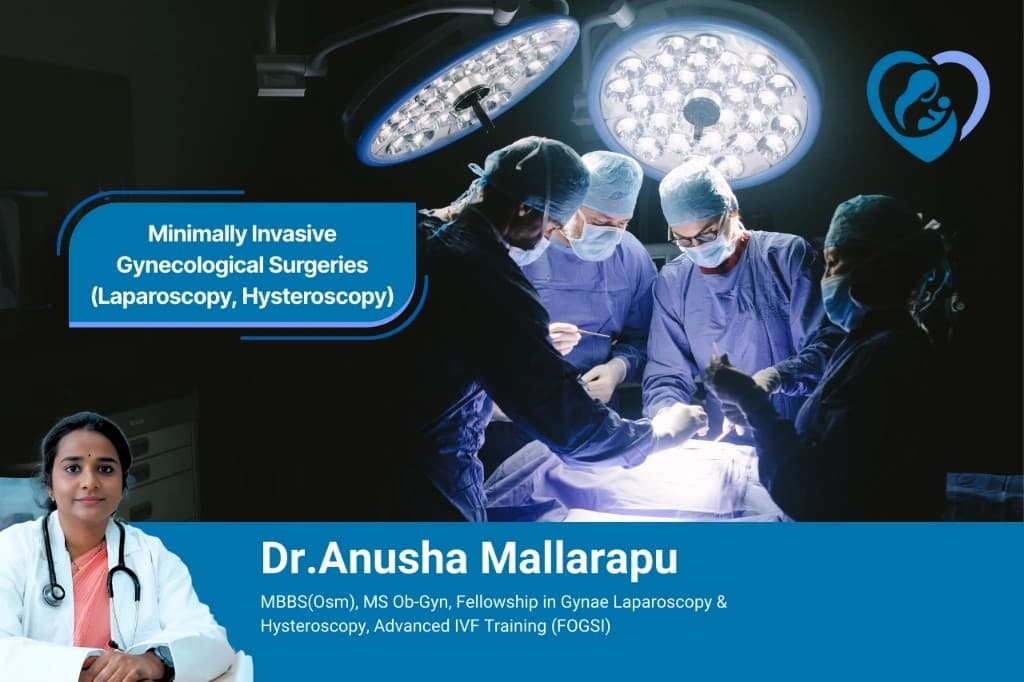
Dr. Anusha Mallarapu plans these operations in Puppalaguda. Her training includes FOGSI fellowships in laparoscopy and hysteroscopy. The decision is made in the clinic, from your symptoms and scans. The operation is arranged at Bhoomi Hospital, where anaesthesia and a theatre are available. The practice lists more than 800 advanced procedures among the care it has provided.
How an operation is planned
Surgery is the last step of a clinic plan, not the first suggestion. The route is chosen before the day.
Confirm what needs treating
Pain, bleeding, a cyst, or a fertility problem is matched to an examination and a scan. A fibroid on an old report is not operated on until its size, position, and your symptoms are current. Some findings are watched. Some are treated with medicine first.
Choose laparoscopy, hysteroscopy, or both
A problem on the outside of the uterus or on the ovary is usually laparoscopic. A polyp or a fibroid that bulges into the cavity is usually hysteroscopic. Some women need both, and that is said at the planning visit so you are not consented for one and woken having had the other without warning.
Consent and the hospital date
You are told what will be removed or treated, what might be found that changes the operation, the anaesthetic, and the likely stay. Blood tests and fitness for anaesthesia are arranged at Bhoomi Hospital. A date is not fixed until those are acceptable.
Recovery instructions before you arrive
You leave the clinic knowing who can take you home, how long to stay off work for this operation, and which symptoms mean a call. Those instructions are repeated at discharge, because they are easier to remember before the anaesthetic.
Laparoscopy is used for
These are the operations discussed most often. Whether one of them is right for you depends on the scan and on whether medicine has already been tried.
Fibroids
A fibroid that causes pressure, heavy bleeding, or a fertility problem can be removed laparoscopically when its position allows a keyhole approach. A very large fibroid, or one that sits in a difficult place, may still need an open incision. That limit is discussed from the scan, not discovered as a surprise preference on the day.
Ovarian cysts
A cyst that is persistent, painful, or suspicious in its appearance can be removed with the ovary conserved when that is safe. The aim is to take the cyst, not to remove an ovary by default. A cyst that looks concerning is planned with that possibility named in advance.
Endometriosis
When pain or a fertility problem is thought to come from endometriosis, laparoscopy can confirm it and treat deposits that are visible. It is not the first step for every painful period. Medicine and a proper history come before a theatre date.
Ectopic pregnancy
A pregnancy outside the uterus is urgent. Laparoscopy is one way it is treated, when you are stable enough for that route. If you have pain and a positive pregnancy test, call rather than waiting for an elective clinic slot.
Who should ask about this surgery
Book a surgical opinion when a scan or a symptom has already pointed to a condition that an operation might treat. The visit can also conclude that you do not need one.
01
A fibroid or a cyst on a scan
Bring the images, not only the written report. Size and position decide whether keyhole surgery is realistic and whether surgery is needed at all.
02
Pain that has not settled
Pelvic pain that continues after a proper trial of medicine is a reason to discuss laparoscopy. Pain of a few days, without a scan, is not automatically an operation.
03
Bleeding from something inside the uterus
A polyp, a fibroid in the cavity, or scar tissue after a previous procedure is assessed for hysteroscopy. An ultrasound that only says “thick lining” still needs a clinic review before a theatre booking.
04
Fertility and a structural problem
A septum, adhesions, or a fibroid distorting the cavity can be part of a fertility plan. The operation is timed with that plan, not done in isolation from the semen analysis and the tubes.
Sudden severe pain, fainting, or shoulder pain with a positive pregnancy test can be an ectopic pregnancy. That is an emergency call, not a request for the next routine surgical clinic.
Hysteroscopy
Hysteroscopy treats the cavity of the uterus through the cervix. It is a different operation from laparoscopy, with a different recovery.
Polyps
A polyp that bleeds, or that was found while investigating fertility, can be removed under vision and sent for a report. You are told whether the procedure is diagnostic only or whether removal is intended.
Fibroids in the cavity
A fibroid that projects into the uterus can often be shaved away hysteroscopically. One that is mostly in the wall cannot. The scan is what separates those two operations.
Scar tissue
Adhesions inside the uterus, sometimes after a previous procedure or infection, can be divided so the cavity opens again. This is planned with the fertility history in mind, and the result is checked rather than assumed.
What the day of surgery involves
You are admitted at Bhoomi Hospital, not at the clinic room. Anaesthesia is required for these operations. Laparoscopy uses small incisions; hysteroscopy uses the vaginal route. The time in theatre depends on what is being treated. You wake in recovery, and someone explains what was found and what was done before you are discharged or kept overnight.
Going home the same day is common for a hysteroscopy and for some laparoscopic procedures. It is not promised for every case. Heavy lifting, sex, and a return to work are timed to the operation you had. Fever, heavy bleeding, severe pain, or pain with vomiting after you are home are reasons to call, not to wait for the review date.
What to bring to the planning visit
- Scan images and reports, and any previous operation notes.
- A list of medicines, especially blood thinners, and drug allergies.
- The first day of your last period, if the timing of surgery depends on the cycle.
- Questions about fertility, work, and how long you will need someone at home.
Call +91 63048 27743 or use the appointment form. The clinic confirms the consultation. The hospital date is set after you have been assessed fit for anaesthesia at Bhoomi Hospital.
Why patients come here for this surgery
01
The surgeon is the doctor who counselled you
Dr. Mallarapu sees you in the clinic and operates at Bhoomi Hospital. The person who explained the scan is the person who does the procedure.
02
Keyhole is chosen when it fits
Laparoscopy and hysteroscopy are used when they can do the job. An open operation is recommended when a keyhole route would be the wrong one, and that is said before the day.
03
Fellowship training in both techniques
The practice lists FOGSI fellowships in laparoscopy and hysteroscopy. The published record of the clinic includes more than 800 advanced procedures.
04
Recovery is described for your operation
You are not given one slogan about being back at work in a few days. The time off matches a polyp removal, a cyst, or a larger procedure, whichever was planned.
Questions about laparoscopy and hysteroscopy
01What are minimally invasive gynaecological operations?
Laparoscopy uses small abdominal incisions and a camera. Hysteroscopy uses a camera through the cervix to treat the inside of the uterus. Compared with opening the abdomen for the same problem, they usually mean less pain, a smaller scar, and a shorter stay. The size of the operation still depends on what is being treated.
02When are they recommended?
Laparoscopy is considered for fibroids, ovarian cysts, endometriosis, and some ectopic pregnancies, when the scan shows a keyhole route is realistic. Hysteroscopy is considered for polyps, fibroids inside the cavity, and scar tissue in the uterus. Medicine and a proper diagnosis come first when they are the safer start.
03What are the practical benefits?
For a suitable operation, a shorter hospital stay, less blood loss than the open alternative, and an earlier return to ordinary activity. Those are comparisons with open surgery for the same condition. They are not a guarantee that every patient goes home the same day.
04How much surgical experience is this based on?
Dr. Mallarapu has fellowships in laparoscopy and hysteroscopy, and the practice reports more than 800 advanced procedures. Experience is a reason to trust the planning. It is not a success rate for your operation. The result depends on the condition and on what the scan allows.
05How long is recovery?
A hysteroscopic polyp removal is often a short recovery. A laparoscopic cyst or fibroid operation commonly needs longer, and many women are back to light activity within about a week, with heavier work delayed. A larger procedure takes longer than that. You are given the interval for the operation you had, plus the symptoms that should make you call.
06Where is the clinic?
Dr. Anusha Mallarapu Clinic is on the first floor of Ideal Investa, Road No. 13, Kundan Nagar Colony, Alkapoor Township, Puppalaguda, Hyderabad 500089. She also consults at Bhoomi Hospital, Plot No. 44, 46 and 48, Puppalaguda–Manikonda Road, near Tapovan Park.
07How do I book an appointment?
Call +91 63048 27743, email dranushamallarapu@gmail.com, send a WhatsApp message, or use the form on the Contact page. The clinic confirms the time by phone or WhatsApp.
08What should I bring to the first visit?
Bring previous prescriptions, scan and blood reports, a list of current medicines, and the questions you want answered. If this is a fertility visit, come with your cycle dates if you know them.
Sources
These public pages explain the topic in general. They are not a description of your own result or a treatment plan from this clinic.
Related notes
- 20 September 2026Laparoscopy and hysteroscopy, explainedHow keyhole gynaecology surgery is planned in Puppalaguda: laparoscopy and hysteroscopy for fibroids, cysts, and problems inside the uterus, done at Bhoomi Hospital.
- 12 September 2026What happens at a pregnancy visit in PuppalagudaWhat a pregnancy visit with Dr. Anusha Mallarapu covers: history, checks, scans, and a birth plan aimed at a safe vaginal delivery.