
What are ovulation induction and IUI?
Ovulation induction uses medicine to help the ovary mature an egg when ovulation is irregular, absent, or needs to be timed. The response is watched on ultrasound. The aim is a mature follicle at a known time, not an unmonitored course of tablets. If too many follicles grow, the cycle is changed or stopped, because the risk of a multiple pregnancy is part of the plan.
Intrauterine insemination places a prepared semen sample into the uterus around the time of ovulation. The sample is washed in the laboratory first. IUI does not replace the fallopian tubes, and it is not IVF. It is used when sperm can still reach an egg, and when the evaluation has not shown a reason to go straight to a more intensive treatment.
Dr. Anusha Mallarapu offers both in Puppalaguda after a fertility evaluation. Her training includes a FOGSI fellowship in infertility. A follicular study sets the day. If several monitored cycles do not lead to pregnancy, or if the results show that IUI is no longer the right tool, she says so and discusses referral for IVF.
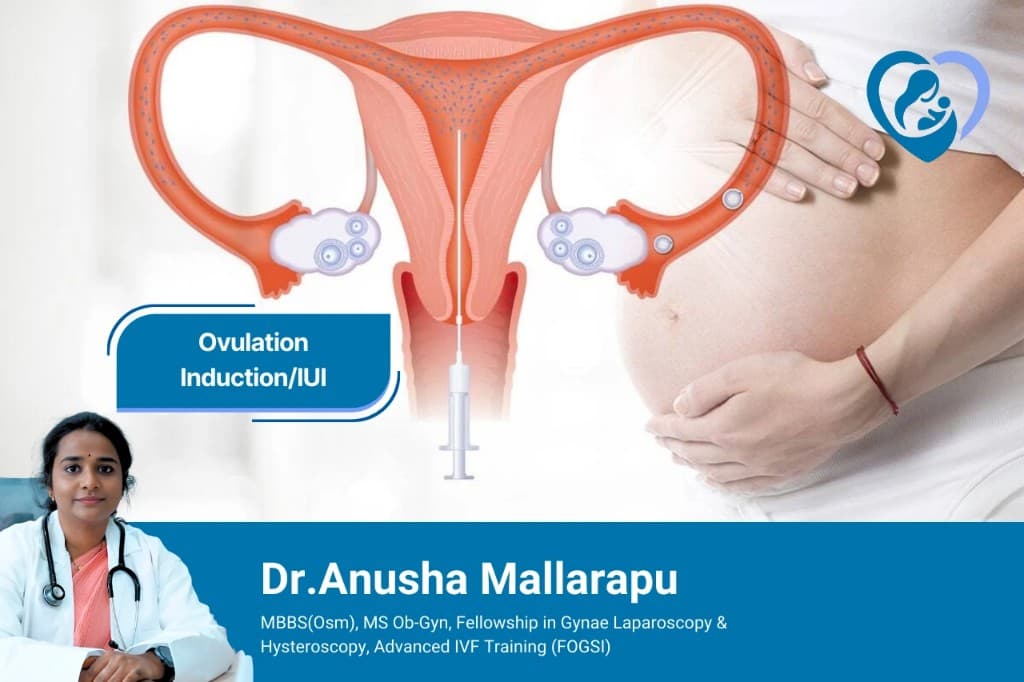
How a treatment cycle runs
The cycle has a start date, scans, a decision about whether to go ahead, and then either timed intercourse or insemination.
Before the medicines
A baseline scan at the start of the period checks that the ovaries are quiet and that a cyst is not already there. The semen analysis and the tubal history are already in the notes. Medicine is not the first conversation if those results are still missing.
Stimulation and scans
Tablets or injections are taken on the days you are told. Scans follow follicle number and size, and the thickness of the uterine lining. The dose is adjusted from those scans. You are told when to come back, usually every one to three days as ovulation nears.
The decision to trigger and inseminate
When a follicle is mature and the number of follicles is acceptable, you are given the timing for ovulation and for the IUI, or for intercourse if insemination is not the plan that cycle. If too many follicles are ready, IUI is not done and you are told why.
After the procedure
You can usually return to ordinary activity the same day. A pregnancy test is timed to the cycle, not taken the next morning. The result, pregnant or not, is used to decide whether another cycle is reasonable or whether the plan should change.
What is monitored
Four checks decide whether the cycle stays on track. They are read together, not as separate tickets.
Follicle number and size
Ultrasound measures how many follicles are growing and how large the lead follicle is. One mature follicle can be the goal. Several may be accepted. A large number is a reason to stop, not a better chance to ignore.
The lining
The uterine lining is measured at the same scans. A lining that stays thin is discussed before insemination, because the egg and the sperm are only half of the cycle.
Hormones when they change the day
A blood test is added when the scan alone does not show whether ovulation is about to happen. It is not drawn on every visit by default. The result, with the follicle size, sets the timing.
The semen sample on the day
For IUI, the sample is produced and prepared the same day. You are told the count after preparation before the insemination goes ahead. A result that is far below what was expected is explained, and the procedure is not treated as automatic.
Who this treatment is for
Ovulation induction and IUI are options after an evaluation, not a first prescription for everyone who wants a baby soon.
01
Ovulation that is irregular or absent
If eggs are not being released, medicine plus scans can produce a follicle that can be timed. The cause, such as a polycystic ovary pattern, is still named. The tablets are not the whole diagnosis.
02
Unexplained delay
When tests have not found a blocked tube or a severe sperm problem, a few cycles of stimulation and IUI are sometimes the next step. How many cycles are reasonable is agreed before the first one, not after several have already passed.
03
A mild sperm problem
IUI can be considered when the semen analysis is reduced but not so poor that insemination is unlikely to help. A severe abnormality is a reason to discuss IVF instead of repeating IUI.
04
Donor sperm or difficult timing
IUI is also used when the sample is donor sperm, or when intercourse cannot be timed. That is arranged only after the rest of the evaluation is clear.
Blocked tubes, a semen result that cannot support IUI, or a reason to move faster because of age are discussed before a stimulation cycle is booked. IUI is not a holding treatment in those situations.
How the cycle is used
Medicine, timing, and insemination are three decisions. Each one can be made without the others.
Medicine for the ovary
The drug and the dose are chosen from your history and the baseline scan, then changed if the follicles over-respond or do not grow. You are told what you are taking and what side effects should make you call. This page does not list doses. Those are set for the cycle in front of you.
Timing from the scan
Insemination or intercourse is booked from the follicle, not from a fixed cycle day. A trigger injection is used when it helps pin ovulation to a known hour. You leave that visit knowing the clock for the next two days.
When to stop and rethink
Too many follicles, a lining that will not thicken, or several completed cycles without pregnancy are reasons to pause. The next conversation may be a different medicine, a look at the tubes, or a referral for IVF. Repeating the same cycle without a review is not the plan.
What the IUI visit is like
The procedure is done in the clinic once the sample has been prepared. A speculum is used, as in a smear test, and a thin soft catheter carries the prepared sperm into the uterus. It usually takes a few minutes. Most women describe cramp or pressure rather than a procedure that needs anaesthesia. You rest briefly and can go back to normal activity the same day unless you are told otherwise.
You are told when to do a pregnancy test and which symptoms should prompt a call before that, including severe pain or bloating after stimulation. A negative test is a result, not a reason to start the next medicine the same day without looking at how the cycle went.
What to arrange
- The first day of the period, reported promptly, so the baseline scan is not missed.
- The man’s availability on the likely IUI morning, or the plan for a donor sample.
- A list of fertility medicines already taken, including any left over from another clinic.
- Earlier follicle charts and semen reports, if this is not your first cycle here.
Call +91 63048 27743 or use the appointment form. The clinic confirms the time by phone or WhatsApp. Once a cycle has started, scan days can fall at short notice. Keep those mornings free.
Why couples have this done here
01
Evaluation, scans, and IUI in one practice
The same doctor who read the work-up monitors the follicles and does the insemination. The cycle is not handed between a scan centre and a separate procedure visit.
02
The response is watched
Medicine is not given without ultrasound. Follicle number is a safety check as well as a timing check.
03
IUI is timed, not assumed
The procedure is booked when a follicle is mature. A fixed day of the month is not used as a substitute for the scan.
04
A limit is agreed
You are told when another IUI is still reasonable and when IVF, or stopping, is the more honest next step.
Questions about ovulation induction and IUI
01What is ovulation induction, and who is it for?
It is medicine to help the ovary mature an egg, used when ovulation is irregular or absent, and sometimes in unexplained infertility. Dr. Mallarapu recommends it after an evaluation, and she monitors the response with ultrasound so too many follicles are not ignored.
02What is IUI?
Intrauterine insemination places a prepared sperm sample into the uterus around ovulation. It is used to bring a reasonable number of moving sperm closer to the egg. It does not treat blocked tubes, and it is not the same as IVF.
03How are the two combined?
Medicine is started, follicles are scanned, and IUI is done only when a follicle is mature and the number of follicles is acceptable. The insemination is booked from that scan. If the response is too strong, the cycle is stopped rather than inseminated anyway.
04What training covers this treatment?
Dr. Mallarapu’s practice includes a FOGSI fellowship in infertility, and more than eleven years in women’s health. The fellowship is the basis for planning the cycle. It is not a quoted chance of pregnancy. Your chance depends on age, tubes, sperm, and how the ovary responds.
05What does the IUI procedure feel like?
It is a short clinic procedure without anaesthesia. A thin catheter is passed through the cervix and the prepared sample is placed in the uterus. Cramp is common. Most women go back to usual activity the same day. You are told when to test and what should make you call sooner.
06Where is the clinic?
Dr. Anusha Mallarapu Clinic is on the first floor of Ideal Investa, Road No. 13, Kundan Nagar Colony, Alkapoor Township, Puppalaguda, Hyderabad 500089. She also consults at Bhoomi Hospital, Plot No. 44, 46 and 48, Puppalaguda–Manikonda Road, near Tapovan Park.
07How do I book an appointment?
Call +91 63048 27743, email dranushamallarapu@gmail.com, send a WhatsApp message, or use the form on the Contact page. The clinic confirms the time by phone or WhatsApp.
08What should I bring to the first visit?
Bring previous prescriptions, scan and blood reports, a list of current medicines, and the questions you want answered. If this is a fertility visit, come with your cycle dates if you know them.
Sources
These public pages explain the topic in general. They are not a description of your own result or a treatment plan from this clinic.
Related notes
- 12 September 2026What happens at a pregnancy visit in PuppalagudaWhat a pregnancy visit with Dr. Anusha Mallarapu covers: history, checks, scans, and a birth plan aimed at a safe vaginal delivery.
- 14 September 2026When a pregnancy needs closer careWhat high-risk pregnancy means at this clinic: closer visits for diabetes, blood pressure, growth, and a delivery plan at Bhoomi Hospital.